At Mobility Infotech, we understand that the urban transportation landscape is in constant flux, primarily driven by the power of intelligent mobile applications. As a company deeply specialized in AI-driven solutions for smooth mobility, shaping the future of AI-driven innovation is not just our goal; it's our daily mission. That's why understanding and leveraging the optimal platforms for taxi booking app development is paramount to us. This blog will delve into the quintessential technological ecosystems and strategic considerations that empower us to create robust, scalable, and highly intuitive taxi booking applications, infused with cutting-edge AI capabilities.
Our Foundational Imperative: Native vs. Cross-Platform Paradigms
When we start developing a taxi booking app, one of our first strategic decisions revolves around choosing between native and cross-platform development paradigms.
- Native Development (iOS: Swift/Objective-C; Android: Kotlin/Java): For us, this approach means building separate applications optimized for each specific operating system. The primary advantage lies in unparalleled performance, an optimal user experience (UX) aligned with platform-specific design guidelines, and full access to device-specific hardware and software functionalities. At Mobility Infotech, we pursue native development for critical performance-intensive modules, such as real-time GPS tracking and complex UI animations. This ensures a superior and fluid user interaction, which is crucial for minimizing latency in ride requests and driver navigation. We focus on UI/UX optimization, leveraging hardware acceleration, and deep platform-specific API integration.
Cross-Platform Development (Flutter/React Native): We also leverage frameworks like Flutter (Dart) and React Native (JavaScript) because they allow us to use a single codebase across both iOS and Android platforms. This significantly reduces development time and cost. While they may not always achieve the absolute native performance benchmarks, advancements in these frameworks have minimized the gap. For Mobility Infotech, cross-platform solutions can expedite our time-to-market for Minimum Viable Products (MVPs) and facilitate rapid iteration cycles. Key technical terms we consider here are code reusability, hot reloading, and a widget-based UI architecture. We often weigh the trade-off of a slight compromise on absolute performance for enhanced development velocity.

Backend Architecture and Scalability: The Engine Room of Our Efficacy
The backend serves as the central nervous system of any taxi booking application we build. It manages critical functionalities such as user authentication, driver/passenger matching algorithms, ride management, and data persistence. For us, a robust and scalable backend isn't just a feature; it's a non-negotiable requirement for handling fluctuating demand and a growing user base.
- Microservices Architecture: This architectural pattern is our preferred choice. It advocates for breaking down a large application into a collection of smaller, independently deployable services. Each service, representing a distinct business capability (e.g., user management, booking, payments), communicates via lightweight mechanisms like RESTful APIs or message queues. For Mobility Infotech, a microservices approach fosters modularity, fault isolation, and independent scalability of individual components, preventing a single point of failure from impacting the entire system.
- Programming Languages & Frameworks: We commonly choose Node.js (Express.js) for its asynchronous, event-driven architecture, ideal for real-time applications. Python (Django/Flask) is excellent for rapid development and its extensive AI/ML libraries, which are critical to our solutions. Java (Spring Boot) provides robustness and enterprise-grade scalability.
- Database Management Systems (DBMS):
- Relational Databases (PostgreSQL, MySQL): We use these for structured data with well-defined schemas, ensuring data integrity and transactional consistency. They are ideal for user profiles, ride history, and billing information.
NoSQL Databases (MongoDB, Cassandra, Firebase Realtime Database): These offer flexibility in data modeling and horizontal scalability, suitable for high-volume, unstructured data like real-time location updates, chat messages, and analytics logs. At Mobility Infotech, we often employ a polyglot persistence strategy, utilizing the most appropriate database for each specific data domain.

Geospatial Intelligence: Harnessing Location-Based Services (LBS) and Mapping APIs
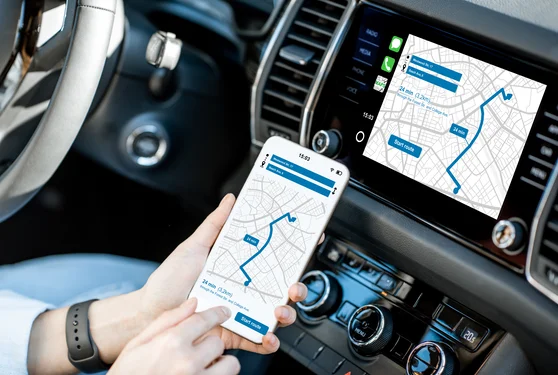
The core functionality of a taxi booking app fundamentally hinges on precise geospatial intelligence. This involves accurate location tracking, route optimization, and real-time navigation. Our specialization in geo-analytics plays a crucial role here, allowing us to effectively manage vehicle demand across various regions.
- Mapping APIs:
- Google Maps Platform: We often rely on its comprehensive suite of APIs, including Maps SDK (for rendering maps), Places API (for search and autocomplete), Directions API (for route calculation and turn-by-turn navigation), and Distance Matrix API (for calculating travel times and distances between multiple origins and destinations). Its robust global coverage and extensive feature set make it a standard for us.
- Mapbox: When highly customizable maps and powerful SDKs are needed, appealing for bespoke UI/UX requirements and specific data visualization needs, we consider Mapbox.
- HERE Technologies: We also look to HERE Technologies for its enterprise-grade mapping data, particularly strong in fleet management and logistics solutions, aligning with our advanced fleet management offerings.
- Geofencing: This technology, defining virtual boundaries on a geographical area, is crucial for us. We use it to designate operational zones, manage surge pricing areas, and detect vehicle entry/exit from specific locations. Mobility Infotech leverages geofencing for dynamic service area management and localized promotional campaigns.
GPS and GNSS Integration: The accuracy of location data relies on robust integration with device-level Global Positioning System (GPS) and other Global Navigation Satellite Systems (GNSS) receivers, augmented by Wi-Fi and cellular triangulation for enhanced precision in urban canyons. This is a critical component of our solutions.
Real-time Data Processing and Communication: The Synapse of Our Responsiveness
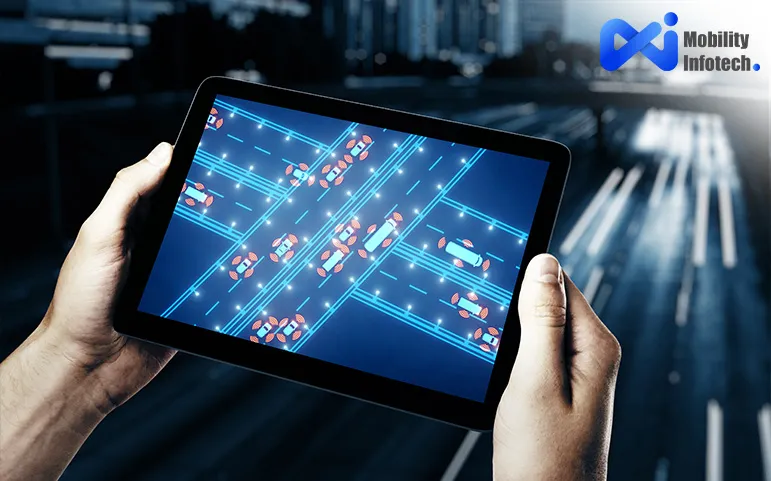
The seamless, near-instantaneous interaction between passengers, drivers, and our backend is absolutely critical for us to deliver a superior ride-hailing experience.
- WebSockets: Unlike traditional HTTP requests, WebSockets provide full-duplex communication channels over a single TCP connection, enabling persistent, real-time data exchange. This is indispensable for live driver tracking, instant ride requests, and in-app chat functionalities. Mobility Infotech utilizes WebSocket implementations for low-latency data synchronization.
- Message Brokers (Apache Kafka, RabbitMQ): We use these distributed messaging systems to facilitate asynchronous communication between different microservices, ensuring reliable delivery of events (e.g., ride status updates, payment confirmations) and enabling a decoupled architecture. This is vital for our event-driven architectures and for handling high-throughput data streams.
Push Notification Services (Firebase Cloud Messaging - FCM, Apple Push Notification Service - APNS): These are essential for us to deliver critical real-time alerts to users, such as driver arrival, ride acceptance, or promotional offers, even when the app is in the background. Effective notification payload management is key to maintaining user engagement.
Integrated Payment Gateways: Seamless Transactional Flow for Our Users
Secure and diverse payment options are fundamental to user convenience and, of course, to the profitability of the solutions we build.
- Payment Gateway APIs: We integrate with reputable payment gateways (e.g., Stripe, PayPal, Razorpay) to provide the infrastructure for processing credit/debit card transactions, mobile wallet payments (e.g., Google Pay, Apple Pay, UPI in India), and to enable secure payment flows. Key technical considerations for us include PCI DSS compliance, tokenization for data security, and multi-currency support.
- Wallet Integration: Implementing an in-app wallet feature allows users to store funds for quick and easy payments, often coupled with loyalty programs and cashback offers – features we frequently incorporate.
Fraud Detection Systems: We employ AI-powered fraud detection algorithms that analyze transactional patterns to identify and prevent suspicious activities, safeguarding both our users and the platform. Mobility Infotech uses sophisticated machine learning models for anomaly detection in payment flows.

The AI Nexus: Predictive Analytics, Dynamic Pricing, and Personalization – Our Core Strength
This is truly where Mobility Infotech distinguishes itself. As specialists in AI-powered solutions and with our proprietary AI-Powered App Builder, AI and Machine Learning (ML) are not just buzzwords for us; they are integral to optimizing operational efficiency and enhancing the user experience. Our advanced fleet management solutions also leverage AI to optimize fleet operations by automatically assigning rides based on driver availability and geographic location, and to effectively manage vehicle demand.
- Predictive Demand Forecasting: We develop AI models, trained on historical data (time of day, day of week, weather, special events), to predict future ride demand hotspots and surges. This enables proactive driver repositioning and resource allocation optimization. Our technical components include time-series analysis, recurrent neural networks (RNNs), and extensive feature engineering.
- Dynamic Pricing Models: Our AI algorithms adjust ride fares in real-time based on demand-supply dynamics, traffic conditions, and anticipated travel time. This ensures market equilibrium, incentivizes drivers during peak hours, and manages user expectations. This involves sophisticated reinforcement learning and optimization algorithms.
- Intelligent Driver-Rider Matching: Beyond simple proximity, our AI considers factors like driver ratings, vehicle type preferences, estimated arrival times, and even historical successful matches to pair riders with the most suitable drivers, minimizing cancellations and maximizing efficiency. We achieve this using collaborative filtering and graph-based algorithms.
- Route Optimization with Real-time Traffic: Our AI integrates real-time traffic data, road closures, and accident reports to dynamically suggest the most efficient routes, reducing travel time and fuel consumption. This involves advanced graph theory algorithms (e.g., Dijkstra's, A* search) with real-time data ingestion.
Personalized User Experiences: Our AI analyzes user behavior and preferences to offer tailored recommendations (e.g., frequently visited destinations, preferred vehicle types), improving user engagement and loyalty. This relies on robust recommender systems and user profiling. Importantly, our AI-Powered App Builder further contributes by providing automated design recommendations and predictive analytics to build sophisticated, user-friendly apps with enhanced features and performance.
Cloud Infrastructure and DevOps: Ensuring Robustness and Agility in Our Solutions
The underlying infrastructure supporting the taxi booking apps we develop needs to be supremely scalable, reliable, and secure. This is non-negotiable for us.
- Cloud Platforms (AWS, Google Cloud Platform, Microsoft Azure): We leverage these platforms extensively. They provide scalable computing resources (e.g., EC2 instances, Google Compute Engine), vast storage solutions (S3, Google Cloud Storage), managed databases, and a plethora of specialized services (e.g., AI/ML services, serverless functions). At Mobility Infotech, we harness the elasticity and global reach of cloud infrastructure for high availability and disaster recovery.
- Containerization (Docker) and Orchestration (Kubernetes): We use Docker containers to encapsulate applications and their dependencies, ensuring consistency across different environments. Kubernetes then automates the deployment, scaling, and management of these containerized applications. This enables us to follow DevOps best practices, achieve rapid deployment cycles, and ensure efficient resource utilization.
- CI/CD Pipelines (Jenkins, GitLab CI/CD): Our Continuous Integration/Continuous Delivery pipelines automate the process of building, testing, and deploying code changes, leading to faster release cycles and reduced human error. At Mobility Infotech, we implement robust CI/CD for agile development and continuous improvement.
Monitoring and Logging: We maintain comprehensive monitoring tools (e.g., Prometheus, Grafana) and centralized logging systems (e.g., ELK Stack). These are crucial for real-time performance tracking, identifying bottlenecks, and debugging issues. This ensures proactive system management and provides us with vital operational intelligence.

Summary
Developing a leading-edge taxi booking application in today's competitive market demands a sophisticated blend of technological expertise and strategic foresight. For us at Mobility Infotech, the "best platforms" are not singular entities but rather an integrated ecosystem. This includes robust native or cross-platform frameworks, scalable microservices architectures, intelligent geospatial technologies (bolstered by our own geo-analytics capabilities), real-time communication protocols, secure payment gateways, advanced AI/ML capabilities (powered by our AI-Powered App Builder for enhanced features and performance, and supporting our advanced fleet management solutions), and resilient cloud infrastructure managed through agile DevOps practices.
By meticulously selecting and integrating these components, we at Mobility Infotech can engineer high-performance, user-centric, and future-proof taxi booking applications. These solutions not only streamline urban mobility but also leverage the transformative power of artificial intelligence to deliver unparalleled efficiency, personalization, and operational intelligence. The continuous evolution of these platforms, coupled with Mobility Infotech's unwavering commitment to innovation, ensures our dominant position in the dynamic ride-hailing industry.
We invite you to learn more about our expertise and how we're shaping the future of mobility at our official website.
Join 6,000+ marketers and subscribe to our weekly newsletter for exclusive social media news, tips and insights you need to boost results.

Dustin Pratt
Dustin Pratt is a software developer passionate about building scalable solutions, writing clean code, and creating apps that make life easier.