

Electric vehicles (EVs) are rapidly transforming the mobility landscape in the United States. As environmental regulations tighten, consumer demand for greener transportation grows, and the total cost of ownership (TCO) for EVs declines, more taxi operators are considering—or actively making—the switch to electric fleets.
However, electrifying a taxi fleet isn’t simply a matter of replacing internal-combustion vehicles with EVs. To realize the full operational, economic, and environmental benefits, taxi operators need software platforms built specifically to support EV use cases: from real-time energy management to intelligent dispatching, predictive battery health monitoring, and cost-optimized charging.
Mobility Infotech, as a provider of sophisticated mobility software, is uniquely positioned to support this shift. Its platform can integrate all crucial components—dispatch, driver apps, charging, data analytics—into a unified, EV-optimized system, helping taxi operators scale sustainably and efficiently.
In this guide, we explore how a software-first approach can enable taxi fleets to transition to EVs, manage them intelligently, and maximize both profitability and environmental impact.
Why EV Fleets Matter for Taxi Operators
Transitioning to an EV fleet is not just a green move — it's a strategic business decision. Here are the core reasons EVs matter for taxi operators, and why software plays a critical role in enabling them:
Lower Operating Costs
EVs typically have fewer moving parts and lower maintenance needs than combustion vehicles, reducing downtime and servicing costs. But to truly leverage this advantage, operators need software to monitor and predict maintenance, schedule proactive checks, and manage battery health.
Regulatory Compliance & Incentives
Governments at various levels (federal, state, city) often provide incentives for EV adoption. Using software to track EV usage, charging, and associated emissions helps taxi operators unlock subsidies, tax credits, or grants more efficiently.
Customer Demand & Brand Differentiation
Eco-conscious customers increasingly prefer low-emission transport. Taxi operators that advertise a green fleet can win loyalty — but to deliver reliably, they need robust apps, accurate ETAs, and smart dispatch to ensure EVs are used optimally.
Sustainability and ESG Goals
For taxi companies aiming to meet ESG (Environmental, Social, Governance) goals, EV fleet electrification is a major lever. Software helps measure, report, and optimize emissions reductions.
Scalability
As the number of EVs in a fleet grows, managing them manually becomes infeasible. Integrated software becomes vital for scaling operations—especially dispatch, charging infrastructure, and fleet performance monitoring.
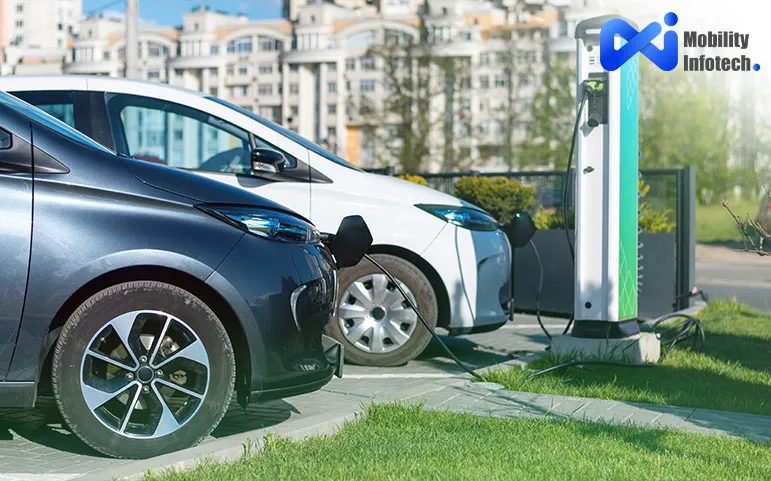
Key Software Challenges When Operating EV Taxi Fleets
Operating EVs brings new complexities that traditional taxi software does not always address. Here are some of the critical challenges that EV taxi operators face, which require specialized software support:
- Battery State Monitoring
Unlike fuel, electricity is not a straightforward resource: the state of charge (SoC), battery temperature, voltage profile, and health all matter. Without real-time monitoring, operators risk vehicles running out of charge, reducing utilization.
- Charging Logistics
Coordinating EV charging across a fleet is complex: where to charge, when (peak vs off-peak), how long, and which vehicles to send. Poor planning can lead to idle time, long queue times, or grid overdraw.
- Range Prediction
EV range is not fixed—it depends on driving behavior, temperature, HVAC usage, traffic, and more. Predicting accurately where a taxi can safely operate before charging is a non-trivial software problem.
- Dispatch Algorithm Complexity
Traditional dispatch works by matching ride requests to nearby drivers. With EVs, dispatch must also account for battery levels, proximity to chargers, and queue times. This multi-dimensional optimization requires advanced algorithms.
- Maintenance and Lifecycle Management
Battery degradation, cell balancing, and other wear-related factors directly affect cost. Operators need insights into battery health, projected lifespan, and when EVs should be retired or replaced.
- Energy Cost Optimization
Electricity costs fluctuate (time-of-day rates, demand charges). Software must help plan charging schedules that minimize electricity cost while ensuring vehicles are ready when needed.
- Data Overload
EVs generate a lot of telemetry (SoC, temperature, charging events, usage). Aggregating, cleaning, and making sense of that data for meaningful decisions requires robust back-end analytics.
- User Experience (Drivers & Riders)
Drivers need to know when they can safely take a trip given their charge, where to charge next, and how to optimize their sessions. Riders need an accurate ETA, no unexpected cancellations due to low battery, and a seamless app experience.

Core Capabilities of an EV-Ready Taxi Software Platform
To address the challenges above, a software platform designed for EV taxi operations must include a set of core capabilities. These are non-negotiable features for a next-gen EV taxi management system:
- Real-Time Telemetry & Fleet Dashboard
- Monitor each vehicle’s battery state of charge, temperature, voltage, and charging history.
- Provide a centralized dashboard for fleet operators to see live and historical data.
- Generate alerts for out-of-range battery values, anomalies, or charger faults.
- Monitor each vehicle’s battery state of charge, temperature, voltage, and charging history.
- Smart Dispatch with EV Awareness
- Dispatch algorithm must factor in EV-specific parameters: SoC, distance to charge stations, predicted energy consumption.
- Dynamic matching that ensures only EVs with safe battery range are assigned trips.
- Load balancing across fleet to avoid overusing particular vehicles or charging stations.
- Dispatch algorithm must factor in EV-specific parameters: SoC, distance to charge stations, predicted energy consumption.
- Charging Station Integration
- Integration with public and private charger networks to locate available stations.
- Reservation systems for chargers (where supported) to reduce queue times.
- Scheduler to plan charging sessions per vehicle based on predicted demand, ensuring fleet readiness.
- Integration with public and private charger networks to locate available stations.
- Range Prediction Module
- Use predictive models (machine learning or statistical) to estimate range based on driving patterns, ambient temperature, HVAC usage, and driving history.
- Provide driver-facing UI to warn when a trip may risk low battery.
- Use predictive models (machine learning or statistical) to estimate range based on driving patterns, ambient temperature, HVAC usage, and driving history.
- Predictive Maintenance Engine
- Monitor battery health, degradation trends, and usage patterns.
- Predict when battery modules may fail or need servicing.
- Suggest preventive maintenance before breakdown or degradation becomes costly.
- Monitor battery health, degradation trends, and usage patterns.
- Cost Optimization & Energy Analytics
- Analyze charging patterns versus electricity rate tariffs to schedule cost-effective charging.
- Forecast energy consumption for the day/week based on demand forecasts.
- Provide financial dashboards tracking electricity cost, per-mile energy cost, and ROI on EV operations.
- Analyze charging patterns versus electricity rate tariffs to schedule cost-effective charging.
- AI-Powered Demand Forecasting
- Use historical ride data, weather, local events, and other features to predict demand surges.
- Use these forecasts to proactively deploy EVs, manage charging, and dispatch efficiently.
- Use historical ride data, weather, local events, and other features to predict demand surges.
- Driver and Admin Applications
- Driver App: Show SoC, recommend nearby chargers, forecast trip viability, give eco-driving tips, and track performance.
- Operator/Admin Portal: Manage vehicles, monitor charger status, set charging schedules, view analytics, generate reports.
- Driver App: Show SoC, recommend nearby chargers, forecast trip viability, give eco-driving tips, and track performance.
- Safety & Compliance Tools
- Geo-fencing of EVs for better control during charging or low-battery scenarios.
- Alerts for out-of-norm battery behavior.
- Recording and reporting to comply with regulations or insurance requirements.
- Geo-fencing of EVs for better control during charging or low-battery scenarios.
- Scalability & Cloud Architecture
- Built on scalable cloud infrastructure so that EV telematics, ride requests, and charging operations can scale as the fleet grows.
- Use of microservices, containerization, or serverless architecture for real-time event processing and analytics.
- Built on scalable cloud infrastructure so that EV telematics, ride requests, and charging operations can scale as the fleet grows.
- Data Security & Privacy
- Secure APIs, role-based access control, and encryption to protect telemetry and user data.
- Compliance with relevant standards (GDPR-like, or U.S.-local data regulation).
- Secure APIs, role-based access control, and encryption to protect telemetry and user data.

How Mobility Infotech’s Platform Enables EV-Specific Operationss
Mobility Infotech is already well established in the mobility software space. Their expertise in taxi dispatch, real-time tracking, AI-based optimization, and app-based operations makes them particularly suited to enable EV-centric taxi operations. Here’s how their platform can specifically support EV taxi operators:
White-Label Taxi Dispatch & Booking Software
Mobility Infotech provides a white-label solution that enables taxi operators to run their own branded ride-hailing app. Operators can thus maintain identity and loyalty while leveraging advanced tech.
AI-Driven Dispatch Optimization
Their dispatch algorithm is powered by artificial intelligence that consumes real-time data (driver location, demand, traffic) to make optimal ride assignments.
For EV fleets, this AI logic can be extended to include SoC, nearby charger availability, and battery risk thresholds to ensure that only EVs with adequate charge are dispatched for trips.
Telemetry & IoT Integration
The platform supports IoT integration, which can capture vehicle telemetry, such as battery health, SoC, temperature, and other EV-specific metrics.
With this, operators can monitor battery health in real time, detect anomalies, and trigger preventive maintenance workflows.
Cloud-Based Fleet Management
Mobility Infotech’s solution is designed on a cloud infrastructure to scale easily. This allows operators to dynamically manage growing fleets of EVs without worrying about on-premise server maintenance or capacity bottlenecks.
Charging Station & Infrastructure Management
- The platform can integrate with charging network mapping/APIs to surface real-time charger availability to drivers.
- It can schedule charging sessions intelligently (based on demand forecast) to avoid bottlenecks and minimize idle time.
- For large fleets, Mobility Infotech’s platform can automate charging queue management: reserving chargers, notifying drivers, and orchestrating when each vehicle should plug in.
- The platform can integrate with charging network mapping/APIs to surface real-time charger availability to drivers.
Demand Forecasting & Dispatch Scaling
Mobility Infotech’s platform is data-driven: it can forecast ride demand patterns using historical usage, peak times, and external signals (weather, events).
These forecasts help EV fleet operators pre-position vehicles, manage SoC buffer, and plan charging ahead of high-demand windows, reducing the risk of “EV shortage” during peak hours.
Eco-Driving Guidance & Driver Tools
The driver app in Mobility Infotech’s ecosystem can provide EV-specific features:
- Real-time SoC and range forecast based on driving style
- Recommendations for “eco driving” (gentle acceleration, regenerative braking usage, HVAC usage)
- Alerts for low battery or suggested charging stops
Predictive Maintenance & Health Monitoring
Using the IoT telemetry, Mobility Infotech’s system can build predictive models to detect battery degradation, imbalances, or thermal issues. When anomalies are detected, the system can:
- Alert fleet managers
- Recommend preventive maintenance
- Generate health reports for each vehicle
Cost Analytics & Reporting
Through their platform, Mobility Infotech can generate granular reports: charging cost per vehicle, per trip energy consumption, daily/weekly energy cost, and even ROI projections on EV adoption.
These analytics support financial planning, help evaluate the business case for EV fleet expansion, and provide data for stakeholders (like investors, regulators).
Security, Compliance & Data Governance
Mobility Infotech ensures data security through encrypted communication, secure APIs, and role-based access controls.
Because EV data is sensitive (battery health, telemetry), it's essential that only authorized users (fleet managers, maintenance) access that data.

Optimizing Charging Through Software: Infrastructure + Dispatch Integration
Charging is one of the most operationally challenging aspects of running an EV fleet. Here’s how a software-first approach — specifically via a platform like Mobility Infotech’s — can optimally handle charging infrastructure, reduce costs, and improve uptime.
Charging Infrastructure Planning & Integration
- Mapping Charger Networks: The system integrates with public and private charging networks to maintain a real-time inventory of available chargers. Drivers via the app can view nearby charging stations, their occupancy, cost, and compatibility.
- Charger Reservation System: When supported by the charging provider, Mobility Infotech’s platform can help reserve charging points for specific vehicles — reducing downtime and uncertainty.
- Smart Scheduling: Based on demand forecasting, the software can schedule which vehicles should charge when, to minimize grid load, reduce queue times, and ensure peak readiness.
Intelligent Charging Dispatch
- SoC-based Dispatch Constraints: The dispatch algorithm ensures that vehicles with lower charge but sufficient to complete a trip are prioritized appropriately. If a ride request exceeds a vehicle’s safe range, it can be deferred or assigned to a different EV.
- Pre-emptive Charging Alerts: Drivers can be notified proactively when they should head to a charger, before their battery becomes critically low or before surge demand.
- Load Balancing to Reduce Energy Costs: The system can align charging sessions to off-peak electricity rates, where possible, especially for depot charging. By shifting charging loads to lower-cost periods, operators can significantly reduce energy expenditure.
Charging Efficiency & Utilization Analytics
- Charger Utilization Reporting: Fleet managers can see which chargers are being used most/least, peak usage times, average queue lengths, and idle waiting time.
- Energy Efficiency Metrics: Analytics on how much energy is consumed per kWh per mile, or per vehicle, help operators understand the efficiency of their EVs and identify underperforming vehicles.
- Carbon Emissions & Sustainability Reporting: The platform can translate energy usage into emissions equivalent (if the grid intensity is known), enabling ESG reporting and sustainability tracking.
Scenario Planning & Scaling
- What-If Modeling: Operators can use software to model “what-if” scenarios — e.g., adding more EVs, installing more chargers, or shifting charging to different times — to forecast impacts on cost, utilization, and revenue.
Growth Readiness: As fleet size increases, Mobility Infotech’s system can scale to support more vehicles, more charging stations, and more complex dispatch-logistics interactions without manual reconfiguration.

Data, AI & Predictive Analytics for Sustainable EV Fleet Management
A key strength of Mobility Infotech’s software is its ability to leverage data, AI, and predictive analytics to maximize EV fleet performance and sustainability.
Demand Forecasting & Dynamic Supply
Using historical ride data, external features (weather, day of week, local events), and real-time signals, the platform builds demand-forecast models. These forecasts feed directly into dispatch and charging decisions:
- Pre-positioning Vehicles: The system can suggest moving EVs to areas expected to have higher demand, ensuring availability while managing battery risk.
- Flexible Charging: If the demand forecast shows a dip, the system might delay some charging sessions to avoid energy cost spikes or grid stress.
Predictive Maintenance for Battery Health
- Battery Degradation Trend Analysis: By collecting telemetry (SoC, temperature cycles, charging patterns), AI models predict how each EV’s battery cells degrade over time.
- Early Warning Systems: The platform can flag vehicles that are diverging from healthy battery profiles and recommend inspection or rebalancing.
- Lifecycle Management: Forecasts for battery lifespan help plan replacements, refurbishments, or decommissioning—ensuring maximum return on EV assets.
Range Prediction & Risk Mitigation
AI models predict the likely usable range for each EV before a trip by analyzing:
- Current SoC
- Historical energy consumption on similar routes
- Ambient temperature and HVAC usage
- Real-time traffic conditions
This prediction helps dispatch safely and confidently — avoiding situations where a vehicle might not complete a trip.
Eco-Driving Analytics & Driver Coaching
- Driving Behavior Scoring: The system tracks metrics like acceleration patterns, regeneration usage, and braking efficiency. Based on this, drivers get an “eco-score.”
- Personalized Coaching: The app provides real-time tips: for example, “maintain a steady speed,” or “tap into regenerative braking,” which can improve range and battery health.
- Incentives for Efficiency: Operators can design driver incentives around eco-driving — better eco-scores lead to rewards, motivating drivers to adopt energy-efficient habits.
Reporting & Governance
- Executive Dashboards: Fleet managers and leadership can view KPIs like average SoC at end-of-shift, energy cost per mile, predicted battery replacement cost, and charger utilization rates.
- Sustainability Reports: The platform can generate ESG-style reports showing carbon savings, energy usage, and efficiency improvements.
- Compliance & Audit Trail: Every EV’s telemetry, charging event, dispatch decision, and maintenance alert is recorded, creating an auditable trail for regulatory bodies or internal governance.

Economic Impact: Cost, Incentives & ROI via Software-Driven EV Management
Switching to EVs is a big capital investment, but with the right software, taxi operators can maximize their return on investment. Here’s how Mobility Infotech’s platform helps in the economic evaluation and long-term profitability.
Total Cost of Ownership (TCO) Modeling
- Integrated Cost Calculator: The platform can model TCO for EVs by factoring in capital cost, energy consumption, maintenance, charging station costs, and battery replacement.
- Scenario Analysis: Operators can compare “ICE vs EV” under different assumptions: number of trips, electricity rates, charger availability, and vehicle utilization.
- Break-even Forecasts: By simulating different usage levels, the software can predict when the additional upfront cost of EVs pays off relative to combustion vehicles.
Leveraging Incentives & Subsidies
- Incentive Management: The platform helps track and apply for relevant grants, tax breaks, or EV-specific subsidies (federal/state).
- Reporting for Compliance: By capturing EV operations data (charging, usage, emissions), the system simplifies reporting to qualify and maintain grants or credits.
Operational Savings Through Efficient Dispatch & Charging
- Reduced Fuel Costs: With EVs, energy cost per mile is generally lower; software optimizes charging timing to off-peak, reducing energy bills further.
- Minimized Downtime: Intelligent scheduling and predictive maintenance reduce unexpected breakdowns. Fewer service days mean more revenue days.
- Higher Utilization: Efficient dispatch ensures fewer “dead miles” (vehicles driving empty) and better matching of EV availability with demand.
ROI & Payback Strategy
- Incremental Adoption: Operators can adopt EVs gradually and use software to monitor financial performance in real time rather than overcommitting.
- Scaling Based on Performance: As software analytics kick in, operators can adjust their EV fleet size, charging infrastructure investments, and usage patterns to maximize ROI.
- Long-Term Planning: The predictive models for battery life and maintenance can be used to plan for battery replacements or second-life usage of batteries, improving asset utilization.
Operational Risks and How to Mitigate Them with Software
Transitioning to an EV fleet is transformative, but it's not without risks. With a strong software backbone, many of these risks can be anticipated and managed.
Risk: Vehicles Running Out of Charge Mid-Trip
Mitigation: Use range prediction + dispatch constraints (only assign trips to vehicles with sufficient SoC), plus proactive driver alerts for charging points.
Risk: Charger Congestion
Mitigation: Integrate real-time charger occupancy data, allow drivers to reserve chargers (if the network supports), and build intelligent charging schedules to avoid peak loads.
Risk: Degraded or Faulty Batteries
Mitigation: Predictive maintenance engine flags battery health issues early, enabling preventive action. Also track thermal anomalies, voltage drops, and other risk signals.
Risk: High Energy Cost
Mitigation: Optimize charging times to use off-peak electricity, use forecasting to plan when and which vehicles to charge, and run cost analytics dashboards.
Risk: Underutilized Fleet
Mitigation: Use AI demand forecasting + smart dispatch to ensure EVs are placed correctly, minimizing idle EVs and aligning supply with demand.
Risk: Data Overload & Poor Decision Making
Mitigation: Provide actionable dashboards, alerts, and insights rather than raw data. Data visualization, anomaly detection, and decision-support tools help operators act.
Risk: Driver Resistance
Mitigation: Through the driver app, provide eco-driving coaching, transparent SoC/range information, and incentives for efficient driving to build trust in EV transition.
Risk: Regulatory or Reporting Failures
Mitigation: Use the platform to maintain compliance data, produce ESG reports, and ensure data governance with secure access and role-based controls.

Conclusion
The electrification of taxi fleets in the United States represents one of the most significant shifts in mobility — combining environmental sustainability with operational efficiency. However, to capture the full value of EVs, taxi operators cannot rely on legacy dispatch or fleet software. They need a next-generation, EV-aware, data-driven platform that is built with the challenges and opportunities of electrified mobility in mind.
Mobility Infotech, with its deep expertise in taxi dispatch software, real-time tracking, AI, and scalable cloud systems, is ideally positioned to power this transformation. By integrating EV telematics, predictive analytics, smart dispatch, charging coordination, and cost optimization into a single platform, Mobility Infotech hardware-agnostic solution enables taxi operators to:
- Transition to EVs without compromising reliability
- Reduce operating costs while improving utilization
- Scale sustainably and strategically
- Generate actionable insights into energy usage and vehicle health
- Manage risk, maximize uptime, and boost profitability through data
For taxi operators ready to embrace a greener future, partnering with a technology provider like Mobility Infotech is not just an option — it’s a competitive imperative.
Summary
In this detailed guide, we explored how taxi operators in the U.S. can electrify their fleets effectively using a software-first strategy. We began by explaining why EV fleets matter for taxi businesses — driven by lower operational costs, regulatory incentives, and environmental demand.
We highlighted the software challenges unique to EV operations, like battery state monitoring, charging logistics, range prediction, and data overload. Then, we laid out the core capabilities of an EV-ready taxi software platform: real-time telemetry, smart dispatch, cost analytics, predictive maintenance, and more.
We dove deep into how Mobility Infotech platform addresses all these needs: from AI-based dispatch, IoT integration, and cloud-scale architecture, to charging station management, forecasting modules, and driver coaching. We explained how software can optimize charging operations, reduce energy cost, and improve fleet utilization.
Next, we discussed the role of data, AI, and predictive analytics in EV fleet management: demand forecasting, battery health prediction, eco-driving scoring, and sustainability reporting. We also covered how operators can model costs, forecast ROI, and leverage incentives to make EV adoption financially viable.
Recognizing risks is critical — we identified key operational risks (e.g., low battery, charger congestion, maintenance) and described how Mobility Infotech’s software can mitigate them. Finally, we concluded with a strategic vision: electrifying taxi fleets is not just a green move, but a business transformation — and with the right software partner, taxi operators can lead this shift profitably and sustainably.
Join 6,000+ marketers and subscribe to our weekly newsletter for exclusive social media news, tips and insights you need to boost results.