
White-Label vs Custom Shuttle Apps: Cost, Time & ROI (2026)
 Jackson Scott
 June 5, 2026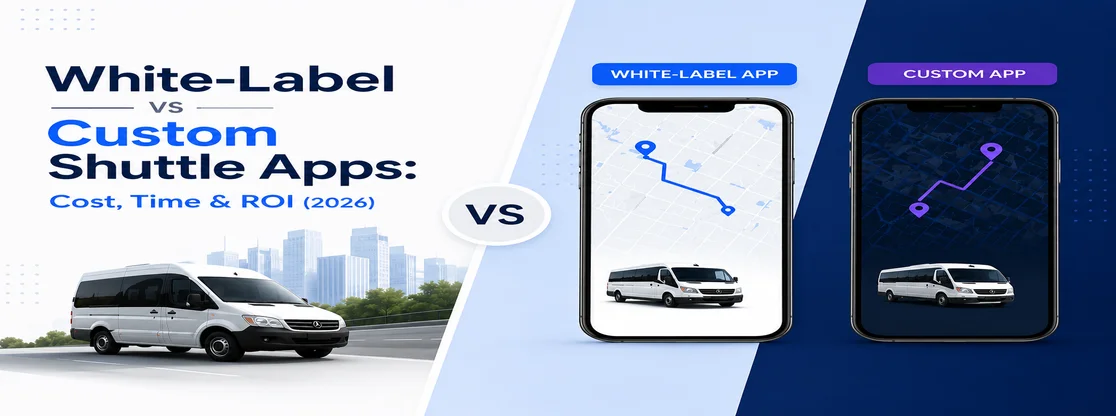
In 2026, the shuttle business is at a fork: commission a custom-built app from scratch, or launch on a white-label shuttle software platform that's already built? It looks like a technical decision, but no, it's not. Moreover, it's a business decision that defines the whole roadmap for - how fast you can launch, how much capital you tie up before earning a single rupee or dollar of return, and how quickly you can adapt when riders, regulators, or clients change what they expect.
The decision has been made; get it right, and you'll live in weeks, breaking even in months. Get it wrong, and you can spend a year and six figures building something that's outdated before it ships.
For that, here's a breakdown of both models across the three dimensions that actually decide the outcome - cost, time-to-market, and ROI.
Let's understand with current 2026 market data and realistic operator use cases to have a clear framework for choosing the right shuttle app software for your fleet, your budget, and your growth plans.
The Core Dilemma: Why This Choice Matters
Shuttle services have moved from being a back-office expense to a strategic asset a long time ago. Now they sit exactly at the crossroads of employee experience, ESG and sustainability reporting, duty-of-care compliance, and operating margin.
Riders now expect Uber-grade experiences from shuttle bus travel too - live tracking, accurate ETAs, in-app booking that travel could be to an office, catching a hotel transfer, or just crossing a university campus.
That rising bar of user experience is clearly reflected in the market. The shuttle dispatch software market grew from $1.23 billion in 2024 to $1.4 billion in 2025 at a 14.1% CAGR, and is projected to reach $2.35 billion by 2029. Behind the bars forces in it are smart-mobility demand, real-time fleet tracking, predictive maintenance, and AI-driven route optimization; these are the non-negotiable capabilities for a shuttle app to deliver now.
Now the actual question here is to decide whether you build those capabilities yourself or rent a platform that already has them.
What Is a White-Label Shuttle App?
A white-label shuttle app is a pre-built, fully functional platform built by a software vendor that you can brand as your own. This includes a rider app, driver app, and admin dashboard; all elements carry your brand logo, colors, and name. Riders never see the vendor's brand.
The underlying technology included in it - booking engine, route optimization, GPS tracking, dispatch tools, reporting all that is already developed, tested, and used by many other operators. You configure it for your routes, fares, and policies, then go live. Think of it as moving into a furnished, move-in-ready building instead of constructing one brick by brick.
Typical traits of white-label shuttle software:
- Subscription pricing - usually a monthly or annual fee scaled to fleet size, often without heavy upfront setup costs.
- Fast deployment - pilots can launch in 2-6 weeks.
- Proven feature set - shuttle booking software, live tracking, driver dispatch, and analytics are battle-tested across existing clients.
- Vendor-managed maintenance - updates, security patches, bug fixes, and OS-compatibility work are handled for you.
- Configurable, not custom-coded - you adjust settings rather than write code.
What Is a Custom Shuttle App?
A custom shuttle app - built from the ground up specifically for your business. You define every feature, screen, and workflow, and developers code it to your exact specifications. You own the source code and control the entire roadmap. Everything is under your control.
This is more equivalent to designing and constructing a building from an empty plot. The result fits your requirements more precisely, but here you carry the full cost, timeline, and ongoing responsibility for the build and everything after it.
Typical traits of custom shuttle app development:
- High upfront investment - you pay for design, development, QA, and deployment before launch.
- Long timelines - 4-12 months is common for a production-ready product.
- Total control - any feature is possible, limited only by budget and time.
- You own maintenance - every update, security fix, and new OS version is your cost and your team's job.
- Best for unique workflows - justified when your operation genuinely can't run on any existing platform.
Cost Comparison: Upfront vs Long-Term
Cost is where the two models diverge most sharply - and where the upfront sticker price hides the real numbers.
Custom Build Costs
Industry data compiled across thousands of app projects puts the average custom mobile app at roughly $171,000 in 2025-2026, with most small-to-mid business apps landing between $50,000 and $120,000. A shuttle app is not any simple software: it needs a rider app, a driver app, an admin dashboard, real-time GPS, route optimization, payment integration, and HRIS connectivity. That complexity pushes most serious custom shuttle builds toward the upper end of that band and often beyond.
Now comes the part most budgets understate: ongoing maintenance predominantly runs 15-20% of the original build cost every year. On a $120,000 build, that's $18,000-$24,000 annually - indefinitely - to keep the app secure, bug-free, and compatible with new iOS and Android releases.
White-Label Costs
White-label shuttle software flips the model completely from capital expenditure to predictable operating cost. Instead of a large initial payment, you pay a recurring subscription, commonly in the $500-$5,000 per month range that depends on fleet size, features, and vendor. Maintenance, updates, and security are bundled in - there's no separate line item eating into your budget each year.
Side-by-Side Cost Comparison
| Cost Factor | White-Label Shuttle App | Custom Shuttle App |
| Upfront cost | Low - often no heavy setup fee | $50,000–$150,000+ |
| Recurring cost | $500–$5,000/month subscription | 15–20% of build cost per year |
| Maintenance | Included (vendor-managed) | Your responsibility |
| Hidden costs | Minimal | Scope creep, QA, infrastructure |
| Cost predictability | High | Lower - 60% of builds exceed budget |
Now the concern is, which is cheaper: white-label or custom shuttle software?
For nearly all small and mid-sized shuttle operators, white-label is considerably cheaper - both initially and over a typical 3-5 year prospect. Custom builds only become cost-competitive at a very large scale or enterprise level when a unique workflow makes generic platforms unworkable.
Time-to-Market Analysis
In shuttle operations, time-to-market is revenue, actually. Every week your app isn't live is a week of manual dispatch, spreadsheet routing, and missed productive gains.
How long does it take to build a shuttle booking app?
- White-label: A pilot can be configured and launched in roughly 2-6 weeks. Because the platform already exists, the work is configuration, branding, and onboarding - not engineering from scratch.
- Custom: Expect 4-12 months from rollout to a production-ready launch, covering discovery, design, development, QA, app-store approval, and driver training. Complex or enterprise-grade builds can run even longer.
That gap is decisive. A white-label operator can be live, collecting ride data, and optimizing routes before a custom build has finished its design phase. In a market where AI-powered dispatch and real-time tracking are becoming table stakes, months of delay translate directly into lost ground against faster-moving competitors.
ROI: Which Model Wins in 2026?
Return on investment is where the decision crystallizes. The parameter that actually defines whether the choice you made of shuttle software is right for your business or not. ROI is a function of how much you spend, how fast you launch, and how soon savings start flowing.
Modern shuttle management software delivers well-documented operational gains: 10-25% fuel savings within the first 90 days of AI route optimization, 12-18% more stops per driver per day, and meaningful drops in overtime and per-employee transport costs. Crucially, those savings begin the day your app goes live - so the faster and cheaper your launch, the faster you reach positive ROI.
Pragmatic ROI Use Cases: A Mid-Sized Operator
Consider an operator running 20 shuttles with a need for booking, live tracking, dispatch, and route optimization.
White-label path:
- Upfront: minimal setup
- Cost: $2,500/month ($30,000/year)
- Live in: 4 weeks
- Efficiency savings begin in month one
- Break-even: roughly 3 months, as fuel, overtime, and utilization savings quickly outpace the subscription.
Custom path:
- Upfront: $120,000 build
- Plus $20,000/year maintenance
- Live in: 9 months
- No savings during the build period
- Break-even: roughly 18 months or more, since the operator must first recover the large build cost after finally launching.
The gap is evident: the white-label operator is profitable and optimizing routes while the custom operator is still waiting to launch - and still paying down the build. For the extensive majority of fleets, white-label wins decisively on ROI in 2026.
When Custom Can Still Win
Custom development earns its premium in specific cases: very large enterprises or transit agencies with hundreds of vehicles, operators with genuinely unique workflows no platform supports, organizations with strict data-sovereignty mandates requiring full code ownership, or businesses building the app itself as a core product to sell.
If you're in one of those situations, the long timeline and high cost can be justified by long-term strategic control.
Real Market Data & 2026 Trends
The market is moving fast, and the direction favors platforms that already have advanced capabilities built in:
- AI-powered dispatch is now standard. Vendors are embedding AI engines for route planning and real-time re-sequencing. Building this from scratch is expensive and time-consuming - white-label platforms include it out of the box.
- Real-time tracking is expected, not optional. Riders demand live ETAs and "where's my shuttle" visibility, and dispatchers rely on it to cut idle time and inbound calls.
- IoT and telematics integration is expanding fleet visibility, feeding live vehicle data into routing and predictive maintenance.
- Cloud-based deployment dominates, enabling multi-site, multi-time-zone operations from a single dashboard - a heavy lift to build, but standard in mature platforms.
Fleets adopting AI-driven routing commonly report measurable results - mileage reductions and on-time performance gains within 30-90 days. The best shuttle tracking app software in 2026 bundles these features as a baseline and not customizations or add-ons, which is precisely why building equivalents from zero rarely pencils out for most operators.
Decision Framework for Operators
Use this quick framework to match the model to your situation. A quick overview of important factors at a glance:
Choose a white-label shuttle app if you:
- Want to launch in weeks, not months
- Need predictable, low upfront costs
- Run a small-to-mid fleet (a handful up to a few hundred vehicles)
- Want AI routing, live tracking, and dispatch already built and maintained
- Plan to start small and scale without re-platforming
- Prefer the vendor to handle updates and security
Choose a custom shuttle app if you:
- Operate a very large enterprise or transit network
- Have unique workflows no existing platform supports
- Require full source-code ownership or strict data sovereignty
- Are building the app as a product to sell
- Have the capital and patience for a 6-12 month build plus ongoing maintenance
A practical questions checklist before deciding:
- How fast do we need to live?
- What's our true total cost over five years, not just the initial one?
- Can an existing platform already do 90% of what we need?
- Do we have an in-house team to maintain a custom app long-term?
- How likely is our model to evolve (new verticals, new cities)?
Conclusion & Recommendations
For most shuttle operators in 2026 and ahead, the math is clear: white-label shuttle software wins on cost, time-to-market, and ROI. It turns a six-figure capital project with a year-long timeline into a predictable monthly cost that goes live in weeks and pays for itself in months. With AI dispatch, real-time tracking, and cloud scalability now standard in leading platforms, the traditional reason to build custom is "no one offers what we need"; now this applies to fewer and fewer operators.
Custom development still has its place for the largest fleets and the most unusual requirements, where total control justifies the cost and wait. But if your goal is to modernize operations quickly, cut fuel and overtime costs, and deliver a rider experience that competes all that without tying up capital or waiting out a long build, a white-label shuttle app is almost always the smarter first move.
Recommended next step: Before committing either way, book a working demo against your actual routes and rider volumes. A live pilot on a white-label platform will tell you in weeks what a sales deck never can, and if it already does what you need, you've answered the build-vs-buy question without spending a year finding out.
Frequently Asked Questions
Q.1 Which is cheaper: white-label or custom shuttle software?
For nearly all small and mid-sized operators, white-label is significantly cheaper. Custom builds typically cost $50,000-$150,000+ upfront plus 15-20% annually in maintenance, while white-label shuttle software runs on a $500-$5,000/month subscription with updates included.
Q.2 How long does it take to build a shuttle booking app?
A white-label shuttle booking app can be configured and launched in 2-6 weeks. A custom build typically takes 4–12 months, covering design, development, QA, app-store approval, and training.
Q.3 Do white-label shuttle apps carry my brand?
Yes. A true white-label platform lets you brand the rider app, driver app, and admin dashboard with your own name, logo, and colors; riders never see the vendor's brand.
Q.4 Is white-label shuttle software worth it for small fleets?
Yes. Even fleets of 5-10 vehicles report meaningful fuel, overtime, and utilization savings after switching from manual dispatch, and low-setup subscription pricing keeps entry low-risk.
Q.5 When does a custom shuttle app make more sense?
When you operate a very large fleet, have unique workflows no platform supports, require full source-code ownership or data sovereignty, or are building the app as a product to sell.

 Mobility Infotech
 September 14, 2026
How an Uber Clone App Can Support Multiple Vehicle Categories and Services
A ride-hailing business rarely stays limited to one type of vehicle for ...
Know More Mobility InfotechSeptember 12, 2026
Taxi Dispatch Software Turkey 2026: Istanbul, Ankara and Izmir Operator Guide
Running a taxi fleet in Turkey is no longer a paperwork job. Meters now ...
Know More Mobility InfotechSeptember 12, 2026
White Label Taxi App Poland: How Warsaw Startups Launch Bolt Alternatives
In June 2024, platforms in Poland spent a Sunday night deleting drivers ...
Know More
Business consultant
Tell us about your vision — Taxi, Carpool, Shuttle, Airport Transfer, Car Rental, or Ride-hailing. We'll show you how fast we can get you live.