
Data-Backed Guide: Gojek Clone vs Grab Clone - Which Works Best in Indonesia?
 Mobility Infotech
 September 15, 2025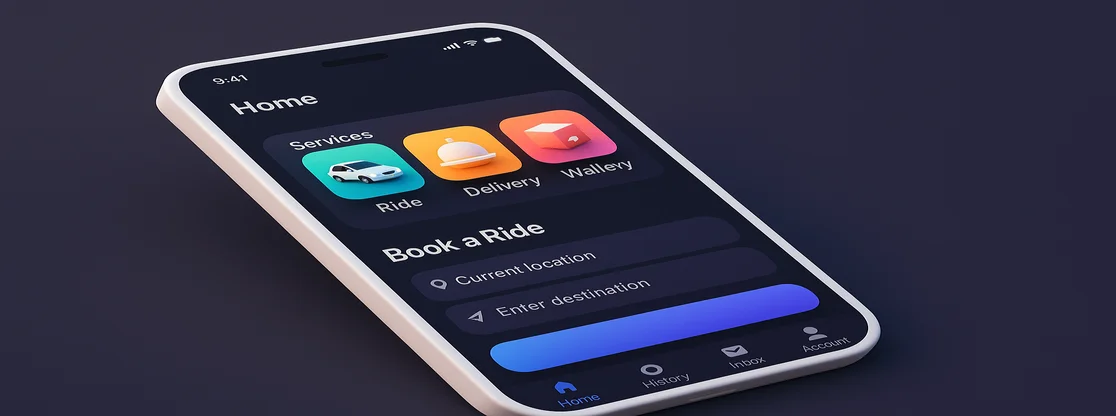
Indonesia is actually one of the best and most successful examples of super apps, with Gojek and Grab being the two most dominant players, holding the largest share in the market. Both are super app covers - ride-hailing, delivery, and payments, which make them daily essentials for millions of Indonesians. In the last decade, Indonesia has been acknowledged as the super app capital of Southeast Asia. They change the way consumers travel, eat, shop, and pay.
If you're a business looking to enter the super app market in Indonesia, a clone app is a viable option. However, the big question often is: Should you go for a Gojek clone or a Grab clone?
Here's a data-backed comparison of both, along with the best clone app providers. Let's get assistance with choosing the right white-label app solution for long-term growth in Indonesia.
Indonesia is the Hotspot for Super Apps
Indonesia is one of the largest digital economies of Southeast Asia, projected to reach $146 billion by 2030, according to the Google-Temasek-Bain SEA Report 2026. The major reason shares here are super apps, which serve as an all-in-one platform that consists of ride-hailing, food delivery, payments, and logistics.
Key Data Points:
- Smartphone adoption: Similar to other global digital economies, over 80% of Indonesians use smartphones as of 2026 (Statista).
- Internet penetration: Here, 78% of the population has internet access; moreover, in urban areas, it's even over 90% (APJII 2026).
- Ride-hailing industry size: Indonesia's ride-hailing industry was valued at $8.5 billion in 2025, which is also expected to cross $12 billion by 2030.
- Digital wallet adoption: Indonesia is a digital economy where more than 70 million Indonesians use e-wallets like GoPay, OVO, Dana, and ShopeePay daily.
- App engagement: Along with the most popular social media apps, Gojek and Grab are consistently in the top 5 most-used apps in Indonesia.
These statistics advocate the fact that Indonesia is the perfect launchpad for super app clones. Despite the dominance of two major players, there still remains a high demand for all-in-one platforms, which can be met by new businesses by launching their own Grab clone app with a little tweak according to ground-level pain point resolutions. This demand can be met by new companies launching their own Grab clone app, customized to address local pain points.
Core Features Comparison: Gojek Clone vs Grab Clone
Both Gojek clones and Grab clones replicate the core services of the respective apps. However, subtle differences in design, service focus, and integration matter when scaling a business.
Here’s a feature-by-feature breakdown:
| Feature | Gojek Clone | Grab Clone | Consideration Notes |
| Ride Options | Car, Bike, Taxi, Auto | Car, Bike, Taxi | Gojek clones often integrate more local transport types. |
| Food Delivery | GoFood-style service | GrabFood-style service | GrabFood dominates SEA in market share, while Gojek has deeper Indonesian loyalty. |
| Parcel Delivery | GoSend equivalent | GrabExpress equivalent | Both serve last-mile logistics effectively. |
| Payment Integration | GoPay-like wallet | GrabPay/OVO-like wallet | Gojek clone leverages QRIS better in Indonesia. |
| Loyalty Programs | GoPoints | GrabRewards | GrabRewards is stronger in cross-border SEA markets. |
| E-Wallet Integration | Deep GoPay model | Strong GrabPay + OVO | Gojek clones perform better in daily micro-payments. |
| Third-Party Services | Groceries (GoMart), Healthcare (GoMed), Entertainment | GrabMart, GrabHealth, GrabInsure | Grab clones often scale faster into adjacent services. |
| Driver Management | Designed for urban density | Optimized for multi-country ops | Depends on whether targeting Jakarta-focused vs. pan-Indonesia. |
Market Performance & User Metrics
Data speaks louder than features. So let's discuss the data to get better insights and reasons to invest in the right clone up for entering the Indonesian market:
Gojek Performance (2026) According to the Data Available:
- Drivers: 1.5 million in Indonesia.
- Users: Over 30 million monthly active users on the app.
- Transactions: GoPay dominates daily micro-transactions; Gojek is a partner with GoPay.
- Stronghold Areas: Jakarta, Surabaya, Bandung (urban density).
- Strength: A well-known brand with loyalty among Indonesians.
Grab Performance (2026) According to Data Available:
- Drivers: 2 million across SEA, 33M+ in Indonesia alone.
- Users: GrabFood leads in order volume per day in Indonesia.
- Transactions: Higher average order value than Gojek.
- Stronghold Areas: Sumatra, Bali, and outer island regions.
- Strength: Holds a superior logistics network throughout the country + partnerships with OVO & merchants.
Key Insight:
- Gojek built its original growth in Indonesia through GoPay, its digital wallet. In urban cities, it also holds a significant grip on the motorbike ride-hailing aspect. So for a Gojek clone, it fits in with markets where it matters - strong integrated wallet system and a bike-first, city-centric model.
- Grab has a strengthening presence in 8+ countries in Southeast Asia. Its key performance and revenue area is food delivery (GrabFood) and logistics (GrabExpress). So for a Grab clone, it fits in with markets where it matters - regional expansion, food, and logistics.
Cost & Scalability Considerations
Building or developing a super app is capital-intensive, which requires an adequate balance between initial investment and long-term flexibility. However, with white-label Gojek clone or Grab clone solutions, launching your app in the market becomes much easier, cheaper, or faster.
Cost Breakdown:
- Development Cost: Roughly starting from $20,000-$60,000, with costs expanding depending on features, platforms, and integrations.
- Infrastructure Costs: Cloud hosting, GPS tracking, and payment gateway setup can add $3,000–$10,000/year.
- Customization: Both clones allow scaling into multi-city operations and adding services like groceries or healthcare.
- Scalability: Grab-style clones are ideal for multi-country expansion, while Gojek-style clones go well with hyperlocal efficiency.
Pros & Cons
Gojek Clone - Pros
- Much faster to launch for the Indonesian market.
- Strong wallet integration, which is also the most used method of payment in Indonesia(GoPay).
- High urban adoption.
Gojek Clone - Cons
- It comes with limited scalability across multiple countries.
- For enterprise use cases, it needs some additional integrations.
Grab Clone - Pros
- Easily scalable across SEA.
- Stronger food + parcel delivery base.
- Strong loyalty/reward systems.
Grab Clone - Cons
- Higher upfront costs.
- For customization, it usually takes longer timelines.
Choosing the Right Clone Matters
Choosing the right clone, along with the right clone provider, will directly affect many core factors for your business, so make sure to select the right one. Decisions can take time, but can't be wrong.
Business Growth - The market share you can capture and the timeframe for achieving it depend on the choice of clone you make. A Grab-clone model may scale faster, but a Gojek-clone model may win better in Indonesia's urban hubs.
Operational Efficiency - Overall integration capability with drivers, merchants, and payment gateways, which are the core of your business's daily operations. So, considerate driver onboarding, merchant tie-ups, and wallet integrations can vary significantly.
ROI (Return on Investment) - User adoption and retention rate define the actual ROI. Choose the right ecosystem for faster adoption and lower churn.
Mobility Infotech Advantage
A company that specializes in custom or white-label solutions designed according to local markets, for example, Indonesia. Our expertise:
- Go live in 4-6 weeks, not months.
- Full custom branding.
- Wallet + QRIS integration is ready for Indonesia.
- Ongoing 24/7 support & scalability consulting.
Ready to capture Indonesia's $8B super app market?
Request a Free Demo and Talk to Our Experts (Smart choices start with conversations - so don't decide in the dark, consult, compare, and then decide).
Conclusion
Indonesia is not at all a simple market to launch new super apps; it's actually a battleground where you need to be well-equipped with detailed insights into each major and minor market to fill the gap. Both Gojek and Grab have proven models, so launching your business with their clones offers a profitable alternative opportunity that just needs to be strategically projected in the market.
Mobility Infotech, with its white-label solutions, is here to assist you in adapting, scaling, and dominating Indonesia's booming super app market.
Frequently Asked Questions
Q.1 What are the key features differentiating Gojek and Grab in Indonesia?
Both are super apps, but their core strengths differ:
- Gojek is stronger in urban, wallet-driven markets. Its integrated wallet (GoPay) is widely used for daily micro-transactions, from rides to food to bill payments. It also dominates in motorbike ride-hailing, which is ideal for crowded Indonesian cities.
- Grab shines in food delivery and logistics. GrabFood leads in daily order volume, and GrabExpress has a robust logistics network. Grab's strength is in multi-service expansion across regions, not just urban hubs.
So, if your focus is on wallet and urban mobility, a Gojek clone is a better fit. If it's delivery + logistics at scale, the Grab clone makes more sense.
Q.2 What are the main business model differences of Gojek and Grab in Indonesia?
- Gojek's model:
- Started as a bike-hailing service, later expanded into payments (GoPay) and super app services.
- It thrives on microtransactions (daily small spends) and urban density.
- Business model = super app for day-to-day essentials.
- Grab's model:
- Started with ride-hailing but pivoted strongly into food delivery, logistics, and financial services.
- It focuses more on larger orders and multi-region coverage.
- Business model = regional expansion + logistics scale.
Gojek = wallet + urban-centric. Grab = logistics + regional scale.
Q.3 How much does it cost to develop a Gojek or Grab clone app in Indonesia?
Building a full super app from scratch is very costly, but white-label clones make it more affordable. Based on 2026 figures:
- Development cost: $20,000 - $60,000 (depending on features and platforms).
- Infrastructure cost: Around $3,000 - $10,000 per year for servers, GPS tracking, payment gateway, etc.
- Customization: Additional cost if you want features like groceries, healthcare, or advanced loyalty systems.
Grab clones typically cost slightly more upfront due to the need for additional logistics/food delivery integrations.
Gojek clones are usually faster and cheaper to launch, especially if focused on urban areas first.
Q.4 Which is better for Indonesia in 2026 - Gojek Clone or Grab Clone?
It depends on your target market:
- If you aim to dominate major cities like Jakarta or Surabaya by leveraging e-wallet adoption and motorbike rides, a Gojek clone is a safer bet.
- If you aim to expand across multiple regions or even countries, and food/logistics is your main play, then a Grab clone will serve you better.
Neither is "better" overall - it's about your business goals.
Q.5 Is a Gojek clone app more suitable for urban areas, while a Grab clone fits regional markets?
Yes, that's exactly how the models align:
- Gojek clone = Urban fit:
- Motorbike rides dominate in crowded cities.
- GoPay wallet adoption is highest in metropolitan areas.
- Faster uptake in dense, urban ecosystems.
- Grab clone = Regional fit:
- Strong logistics for covering outer islands and smaller towns.
- GrabFood and GrabExpress are designed for large-scale delivery.
- It is easier to scale across provinces and borders.
So, yes: urban = Gojek, regional expansion = Grab.
Q.6 How long does it take to launch a Gojek or Grab clone app in Indonesia?
With white-label solutions like Mobility Infotech's:
- The timeline is around 4-6 weeks to get your app live (Mobility Infotech can even make you go live within 3 weeks).
- Custom branding, payment gateway (QRIS, GoPay, OVO), and driver/merchant onboarding can all be set up within this window.
- If you opt for more extensive customizations (multi-country features, large delivery modules), the timeline can stretch to 8-10 weeks.
Compared to building from scratch (which could take 6-12 months), clones save a huge amount of time and money.
 Mobility Infotech
 September 22, 2026
BlaBlaCar Clone Nigeria Start an Intercity Carpooling Business Lagos to Abuja
Thousands of Nigerians already ride-share between Lagos and Abuja. Many ...
Know More Mobility InfotechSeptember 17, 2026
Carpooling App Development UAE Build a BlaBlaCar Rival for Dubai Commuters
Most founders who pitch a carpooling app in Dubai have not read the rule...
Know More Mobility InfotechSeptember 16, 2026
BlaBlaCar Clone Poland: Start an Intercity Carpooling Business Step-by-Step
Here is a gap most Polish founders never notice. Bolt has around 2.3 mil...
Know More
Business consultant
Tell us about your vision — Taxi, Carpool, Shuttle, Airport Transfer, Car Rental, or Ride-hailing. We'll show you how fast we can get you live.