
How to Choose the Right Fleet Management Software for Your Australian Business
 Mobility Infotech
 October 8, 2025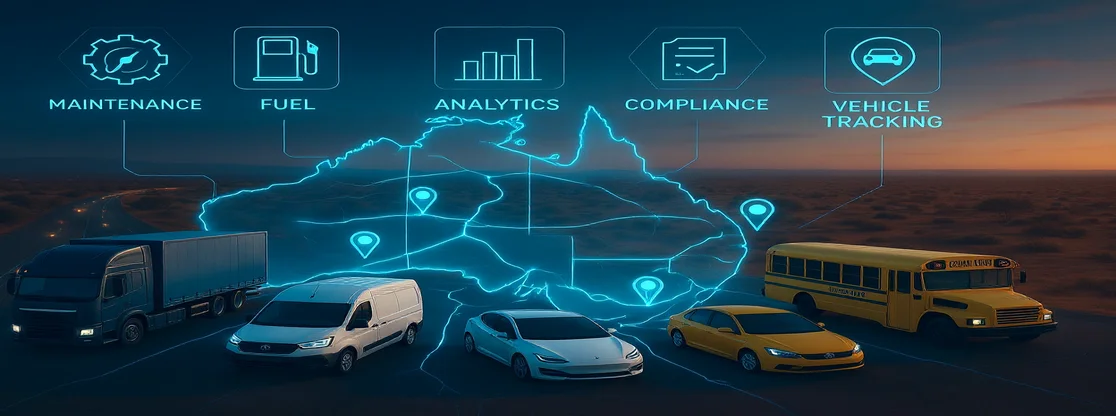
When we talk about fleet management software, it could be for managing any of these - cars or trucks, delivery vans and school buses, heavy construction equipment or even ride-hailing vehicles. Regardless of the type of vehicle or vehicles you operate, choosing the right fleet solutions for businesses can completely transform the way you run your business in a better way. It will improve efficiency, reduce costs, and ensure complete control over every vehicle or fleet you have on the road.
Managing a fleet is complex; that's a fact, no debate about it. From vehicle tracking, driver management, maintenance scheduling, compliance, fuel usage, and more, all that needs to be aligned. So let's get into the steps or a checklist for Australian fleet businesses and operators to identify, evaluate, and adopt the best solution.
Why fleet management software matters in Australia
Before getting into how to choose, first lets be clear on why it matters, and that why can be justified with understanding the Australia's vast geography which presents different challenges for the fleet operations - long distances, fluctuating fuel prices, and diverse terrain these are most common concerns in Australia and that make it more essential to make a data-driven decision on why fleet management software is becoming essential for Australian fleets.
- The Australian and New Zealand installed base of fleet telematics systems is projected to reach 2.7 million units by 2028, growing at a compound annual growth rate (CAGR) of ~11.5 %.
- Major providers in the ANZ region (Australia/New Zealand) include Teletrac Navman, Mobility Infotech, EROAD, MTData, Netstar, and international players like Geotab.
- Globally, the fleet management software market is large and expanding - expected to reach tens of billions in value, fueled by telematics, IoT, AI, cloud analytics, and regulatory pressures.
- Locally, Australian fleet operators face regulatory challenges (e.g. Chain of Responsibility rules, fatigue management, telematics mandates, emissions, road user charge regimes) that make better tracking, driver behaviour analytics, and audit capabilities more than "nice to have" but a must-have.
- With the increasing adoption of electric vehicles (EVs) and hybrid fleets, integrations with battery diagnostics, charging schedules, and energy usage have become additional differentiators.
Extract: The stakes are high. A wrong fleet software choice can cost you more than you think in the form of wasted capital, inefficiencies, compliance risks, and frustrated users. Choosing it well is definitely a worthy and strategic investment.
7 Step guide to choosing the right fleet management software
Now it's clear why the software is needed now comes to real deal, a structured process you can follow to make sure you are choosing the right one for your fleet business in Australia.
Step 1: Clarify your business needs and objectives
Before looking at vendors or feature lists, internally define the fundamental things that must be clear before all that:
- Your fleet scale & complexity
- How many vehicles/assets do you currently manage? (Trucks, vans, service vehicles, plant & equipment)
- What is your growth outlook (3-5 years)?
- Are vehicles homogenous or mixed (heavy trucks, light vehicles, refrigerated, trailers, machinery)?
- Core pain points you want to solve
Examples:- Poor route planning and wasted kilometres
- High fuel consumption / inefficient driving behaviour
- Unplanned breakdowns & maintenance costs
- Compliance and audit risk (safety, fatigue, chain of responsibility)
- Lack of real-time visibility in operations
- Inefficient driver assignment, dispatching, or field workforce coordination
- Regulatory, audit, and reporting needs
- Do you require custom reporting for Australian regulators (e.g. Chain of Responsibility, EWD / EWD-type rules)?
- Are there safety/incident tracking, black box or dash cam requirements?
- Do you need in-built audit logs, tamper-proof records, or data export for regulators?
- Integration requirements
- Do you already run ERP, accounting, payroll, CRM, or maintenance systems that must integrate?
- Must it link to fuel card providers, telematics hardware, IoT sensors, battery / EV systems?
- User & stakeholder roles
- Who will use the system (fleet manager, operations, dispatchers, drivers, finance)?
- What skill levels or mobile/remote access do they have for this?
- What different levels of permission or dashboard accesses per user type do you need?
- Budget constraints and ROI expectations
- What is your budget for the software and its implementation like the cost you are thinking about putting in?
- What is the payback horizon (e.g. 12, 24, 36 months) you are expecting?
- Which metrics will you judge as a success by (e.g. fuel savings, reduced downtime, more utilisation)? Just be clear on that.
Once all these are clearly documented, you can use them as your rubric while evaluating different vendor proposals.
Step 2: Feature checklist - must-haves and differentiators
When evaluating candidate software providers, ensure they meet your core requirements first, and then assess optional or advanced features like AI automation and all to make it more relevant in this 2025 digital era and beyond. Below is a sample checklist you can adapt:
| Feature Category | Essential / “Must-Have” | Differentiators / “Nice-to-Have” |
| Vehicle & asset tracking | Real-time GPS location | Geofencing alerts, zone-based rules, reverse geocoding, offline mode |
| Driver behavior & safety | Harsh braking, speeding, idling alerts | Driver scorecards, coaching workflows, video telematics/dash cams, fatigue alerts |
| Maintenance & diagnostics | Scheduled service reminders, fault code alerts, maintenance cost tracking | Predictive maintenance, OEM diagnostic integration, parts inventory, workshop management |
| Route planning & dispatch | Basic route assignment, mapping | Dynamic route optimization, multiple stops, live rerouting, route templates |
| Compliance & reporting | Audit logs, custom reports, export to CSV/PDF, compliance templates | Automated regulatory reporting (Australian standards), chain-of-responsibility modules, tamper-proof logs |
| Dashboard & analytics | Usage summaries, utilisation % | AI insights, anomaly detection, benchmarking, benchmarking vs peer fleets |
| Alerts & notifications | SMS / email / in-system alerts | Mobile push notifications, escalations, role-based alerting, rule engine |
| Mobile / driver app | Simple app for driver tasks (e.g. tasks, status updates) | In-cab instructions, e-forms, proof-of-delivery, signatures, image capture |
| Scalability & configurability | Support for more vehicles / assets | Multi-brand, modular features, white-labelling, multi-tenant if you are service provider |
| Integration & open APIs | Ability to import/export data (CSV, API) | Rich API, webhooks, connectors to ERP/CRM, telematics hardware-agnostic |
| Security & data compliance | Role-based access, encryption, audit logs | Local data residency, GDPR / Australian data protection compliance |
| Support & training | Vendor onboarding/training, helpdesk | Local Australian support, SLAs, account manager, custom support packages |
Evaluate each vendor on the basis of this checklist, and score or weigh them based on your priorities, your budget and of course your future outlook of the business, as this investment is for the long run.
Step 3: Localisation & Australian context matters
Because you're operating in Australia, there are a few special considerations that must be followed to operate in Australia:
- Regulatory compliance: Local vendors might already include modules for Australian safety standards, fatigue/chain-of-responsibility compliance, reporting to regulators, etc.
- Data residency & latency: There’s businesses that may prefer Australian-hosted servers for data sovereignty, lower latency, or to satisfy internal privacy policies. Be sure of that as if it's falling under your requirement.
- Hardware compatibility & local support: Local hardware providers or resellers are assumed to be better able to assist with installation, spares, and servicing. But with cloud-based fleet management software, it minimises the need for on-site servicing.
- Local knowledge & support: A vendor with an Australian office is good, but a support team outside of Australia that better understands the local transport environment, regulation changes, and can respond faster is also a worthy option.
- Telematics & region adoption: In Australia, top players in fleet telematics include Teletrac Navman, EROAD, MTData, and Netstar. But for small fleet businesses, Mobility Infotech is also a great choice.
- National frameworks & telematics initiatives: Changes in national telematics, remote monitoring, and Advanced Telemetry initiatives may require standards compliance.
- Vehicle types & remote geographies: Some fleets operate in remote, low-coverage or rural areas - offline operation, fallback/buffering, satellite backup, robust connectivity matters.
So, when you evaluate a vendor, ask: "What's your track record in Australian fleets? Do you support local regulatory modules? Where are your servers located, or is it available to be hosted in Australia? Do you have on-ground support?"
Step 4: Shortlist vendors & request proposals/Demos
With your internal requirements and feature checklist handy, you are now well-equipped to shortlist the one that can go with your fleet operations. Now, all you need to do is ask the vendors to present their proposals or Demos with free trials, if available, to evaluate better. Key steps:
- Create a request for proposal (RFP) or request for information (RFI)
- Include your requirements, feature checklist, data volume, expected growth, integration points, and expected timeline to get live.
- Ask for reference clients in Australia, especially similar fleet size/industry
- Ask vendors to run a pilot or proof-of-concept
- Ideally, test the software on a small number of vehicles (e.g. 5-10) for 2-4 weeks
- During the pilot, assess ease-of-use, stability, responsiveness, integration, and real-world performance
- Evaluate vendor responses carefully
- Did they meet all your must-haves?
- Which differentiators did they exceed on?
- Are there hidden costs (e.g. scaling costs, user licensing, premium modules)
- What is the support model, training, SLA, and upgrade policy?
- Examine their roadmap: are they innovating, adding features you may need later?
- Check reference clients and reputation in Australia
- Ask for Australian customers, you can talk to
- Check independent reviews (Capterra, SoftwareSuggest) for Australian users
- Evaluate vendor stability, financial backing, and commitment to updates
Step 5: Cost modelling & ROI analysis
It’s essential not just to pick the vendor, but to model the total cost of ownership (TCO) and expected return on investment (ROI). Some cost and revenue factors to include:
Cost components
- Software subscription / licensing
- Many solutions adopt a Software-as-a-Service (SaaS) per-vehicle per-month model
- In Australia, monthly subscription fees vary and are often “quote on demand” depending on features, scale, and modules.
- Hardware costs
- Telematics devices, sensors, dash cams, sensors, GPS units, wiring
- Installation and commissioning
- Implementation & integration
- Data migration, system integration, custom development, training
- Support, maintenance & upgrades
- Ongoing vendor support, updates, premium-level SLA
- User licenses, accounts, add-on modules
- Some vendors charge extra for advanced modules (e.g. route optimization, AI analytics)
- Connectivity / data costs
- SIM cards, data plans, communications overhead
- Change management / staff time
- Time for training, adoption, adjustment period, process redesign
Revenue / savings (benefits) to model
- Reduced fuel consumption and more efficient routes (often large savings)
- Lower maintenance and downtime costs (fewer breakdowns, planned servicing)
- Better vehicle utilisation (more trips per asset)
- Reduced compliance / audit risk costs
- Insurance premium reductions (if safety / driver monitoring lead to fewer incidents)
- Labor / dispatch efficiency gains
- Avoided “manual” costs, admin burden, better reporting
A common rough benchmark in international literature is that fleet software might cost USD 15-50 per vehicle per month, though this is a rough reference; the real cost will depend heavily on features, scale, and region. But still having a rough estimate is a better start to have.
Use your internal metrics to forecast payback. For example: if software + hardware costs $50,000 in Year 1, but you expect fuel, repair, admin savings of $20,000 per year, you may see ROI over 2-3 years.
Step 6: Select vendor, onboard, roll out in phases
Once you select a vendor, these are next steps:
- Sign contracts with clear SLAs and milestones
- Ensure you include stages (pilot, phased rollout, full deployment)
- Agree on deliverables, training, support, performance guarantees
- Pilot / phased rollout
- Start with a subset (e.g. small region, one vehicle type)
- Monitor key performance indicators (KPIs) - fuel, utilization, maintenance, driver compliance
- Collect feedback from users (drivers, dispatch, managers)
- Change management & training
- Train all user groups (fleet ops, drivers, maintenance, admin)
- Document workflows, best practices
- Communicate benefits and leadership support
- Full deployment & monitoring
- Roll out to entire fleet
- Monitor for exceptions, designate a “champion” or superuser
- Conduct periodic review, adjust rules, alerts, thresholds
- Review & continuous improvement
- Use analytics, dashboards, anomaly detection
- Reassess feature adoption, integrate new modules
- Plan for scaling, upgrades, hardware refresh
Step 7: Ongoing evaluation & vendor relationship
- Quarterly reviews: Are you meeting expected ROI? Are features being fully utilized?
- Vendor roadmap: Are they innovating (e.g. adding AI, predictive maintenance, EV compatibility)?
- Support & customer satisfaction: Are they responsive, improving?
- Renewals / renegotiations: At renewal, re-bid if needed
- Expansion & upgrades: Add new modules or assets as your operations grow
How does Mobility Infotech fit in?
As you assess vendors, it's valuable to benchmark them against the local players. Mobility Infotech is one such provider worth considering. Some points to consider when evaluating Mobility Infotech:
- Does Mobility Infotech provide full telematics + fleet management modules (tracking, alerts, maintenance, analytics, driver safety)?
- How does their pricing compare (subscription, hardware, support)?
- What is their Australian presence/support?
- Do they integrate with Australian regulatory modules (Chain of Responsibility, local reporting) or APIs for local systems?
- Do they allow integration with third-party devices, or are they hardware-locked?
- What are their reference clients in Australia?
Well, the answer to all these questions is yes, Mobility Infotech do provide these features, but to get a more detailed view of all you need to book a free demo where you can clearly see the live difference and features they have. Mobility Infotech is basically a white label fleet software provider that also provides custom fleet software, the pricing and feature customisation of which are alterable to your expected priorities. Along with other vendors in your shortlist, include it and evaluate all of them against the features in the checklist and cost criteria.
Frequently Asked Questions
Q.1 How much does fleet management software cost per vehicle?
The cost varies significantly by region, feature set, vendor, hardware, scale, and modules. As a rough benchmark, international literature suggests USD 15–50 per vehicle per month for basic to mid-tier software + service costs.
In Australia, many vendors use subscription pricing per tracked asset. Mobility Infotech, for example, says pricing depends on the number of assets, using a subscription (SaaS) model.
However, you should always request a complete quote, including hardware, installation, support, connectivity, and integration costs, to understand your actual per-vehicle cost.
Q.2 Is fleet management software worth the investment?
Yes - when chosen well, fleet management software can pay back with:
- Fuel savings & optimised routing
- Reduced maintenance breakdowns
- Better vehicle utilisation
- Reduced insurance and incident costs
- Labour savings in dispatch, admin, and compliance
- Audit / regulatory risk reduction
But it's only "worth it" if adoption is strong, features align with actual pain points, and the vendor is committed. Do a detailed cost-benefit analysis and pilot phase to validate the investment.
Q.3 Who is the global leader in fleet management?
There is no single universal "global leader," but some names often cited are:
- Geotab - One of the largest fleet telematics providers globally, with millions of connected vehicles across many regions.
- Wialon (Gurtam) - The Wialon platform is widely used in many countries and is hardware-agnostic.
- Mobility Infotech - white-label fleet management software provider for Australia, catering to taxi, shuttle, and car rental services. Their platform provides real-time GPS tracking, route optimisation, and driver & booking management.
- Samsara - Known for combining IoT, video, and cloud analytics.
- Teletrac Navman - Strong in the ANZ region, combining local presence and global scale.
Which one is "best" heavily depends on your operating region, fleet type, features, support, local compliance, and user experience.
Q.4 What pricing models do Australian fleet software vendors use?
In Australia, fleet management vendors commonly adopt software-as-a-service (SaaS) subscription models, charging a monthly fee per vehicle or asset.
Some may also include hardware costs, installation/commissioning costs, premium modules, and connectivity costs. Be careful about "base" vs "all-in" quotes.
You may also encounter licenses, tiered pricing (volume discounts), or bundling (e.g. hardware + software + support).
Q.5 How do I evaluate data accuracy and reliability in fleet tracking?
Data accuracy and reliability are critical. Key checks include:
- GPS accuracy: how often is the location updated? What is the margin of error?
- Data latency: delays between the vehicle event and the data reaching the dashboard
- Offline / coverage fallback: how the system handles low-signal / rural areas (buffering, reconnection)
- Sensor accuracy & fault tolerance: e.g. accelerometers, odometer, fuel sensors, diagnostics
- Data integrity & redundancy: Does the vendor have backup/disaster recovery?
- Real-world testing/pilot: compare actual known distances, times, and events against what the system logs
- Vendor transparency: ask for raw logs, sampling, and device calibration metadata
These metrics ensure that alerts, analytics, and decisions you make based on the system are grounded in reliable data.

 Mobility Infotech
 September 15, 2026
Fleet Management Software Turkey: GPS, Maintenance & Driver Scoring for Istanbul Fleets
Here is a number that should worry every fleet owner in Istanbul. Averag...
Know More Mobility InfotechSeptember 14, 2026
Taxi Dispatch Software Nigeria 2026 Lagos & Abuja Operators Complete Guide
Most operators think a licence is about paperwork. In Nigeria, it is now...
Know More Mobility InfotechSeptember 12, 2026
White Label Taxi App UAE: Launch Your Ride-Hailing Brand in 30 Days
Dubai's ride-hailing market is growing, but entering it is not as simple...
Know More
Business consultant
Tell us about your vision — Taxi, Carpool, Shuttle, Airport Transfer, Car Rental, or Ride-hailing. We'll show you how fast we can get you live.